
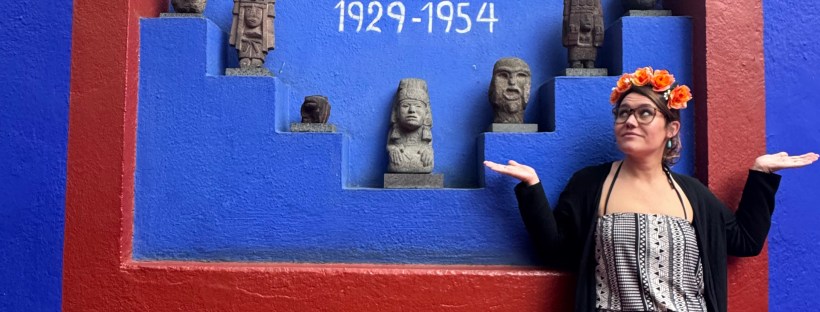
I was just able to make out the rainbow of houses down below, and could see the streets coming into focus between them. Red, yellow, blue, pink, orange houses lined up, each a different color, seemingly never two of the same color side by side. My favorite bright Mexican colors, my dream palette had finally come to life. I long to live in houses like Frida Kahlo’s. It was a short flight from Phoenix, just under 3 hours. My overdue date with Mexico City was set years ago. I was always fascinated by my closest international neighbor, Mexico, it felt so near and familiar to me, but I knew that deep in the heart of Mexico was much different than the border town I grew up with. The more I learned about its culture and ancient magical history, the more curious I became. The intellectual journey perhaps first began in the 6th grade on a deep dive into the history of the Mayans. Some of you might remember that educational gem, The Voyage of the Mimi, featuring none other than a very young Ben Affleck! A team of explorers end up at ancient Mayan ruins in Mexico. Many years later, I completed an upper level history course at CSU entitled, “Mexico”. I couldn’t get enough. I had so many questions.
FOOD
I checked into my hotel in Mexico City around 6 pm, it was in the heart of everything – La Reforma. It was Saturday, and we promptly set out to find some food. We walked down La Reforma (a large and busy city street) and ended up at a place called Cantina La No. 20, near El Angel de la Independencia. I didn’t realize I would get my chance so quickly to try the famous crickets of Mexico. They were dotted along the top of the guacamole and drizzled with my beloved cotija. Leading up to that moment I was not convinced that I would actually do it, but not one to back down from an adventure – once we sat and the opportunity arose, I had to. I scooped up the crispy little cricket, enveloped in guacamole and a corn chip- and to my dismay the cricket fell off the chip before making its way to my mouth. It landed safely on the table. I scooped it up and tried again. I wished I hadn’t, it really didn’t blend into the mixture as well I could have hoped.
My back teeth found the tiny exoskeleton and as they pressed down I could feel its body contort under the pressure, almost a sort of grinding between the teeth, rather than the expected salty crunch like a chip might make. My eyebrows rose ever so slightly, I continued to chew, and swallowed. I made no mention, and casually proceeded with the rest of my food. It’s not something I’m likely to try again. But it is done.


The following day the restaurante del dia was Villa Maria – Polanco, a bright yellow and wonderfully decorated restaurant where Mariachi’s serenade you below vaulted, colonial ceilings. There I tried my first tortilla soup in Mexico, and we finished off the meal with a round of desserts, including flan and of course, churros. It was delectable. Other folks at the table ordered a variety of wonderful dishes throughout the meal, from Sopa de Flor Calabaza (a new favorite of mine), to Lengua, and a spread of Mexican desserts.


On our final night in Mexico City, we visited Teraza Cha Cha Chá – a lovely rooftop bar that offered a glorious view over the Monumento a la Revolución, a grand structure commemorating the Mexican Revolution. The building was created to hold the congressional chambers of the deputies and senators, but the project was not finished due to the Mexican Revolution, and then was eventually converted instead to a monument. The art deco creation stands as a lone structure, hovering over the Plaza de la Republica – a seemingly favorite hang out spot for locals. At night from my hotel room I was able to see the structure light up, one night in blue, and another night in red. At Teraza Cha Cha Cha, I ordered the Tacos de Flor De Calabaza, or squash blossom taco with Oaxaca cheese and topped with molcajete sauce. I have never encountered such a creation before, and am eager to do so again!


Perhaps my favorite meal throughout the week was in historic Puebla, Mexico, at Mural Poblanos. The home of the famous Chiles en Nogada, which I would have ordered, except it wasn’t in season. For that I’ll have to stop by in August and September during the celebration of Mexican Independence Day,
“The traditional chile en nogada is from Puebla; it is tied to the Mexican independence since it is said they were prepared for the first time to entertain the future emperor Agustín de Iturbide[4] when he came to the city after the signing of the Treaty of Córdoba. This dish is a source of pride for the inhabitants of the state of Puebla.[5]” (Wikipedia)
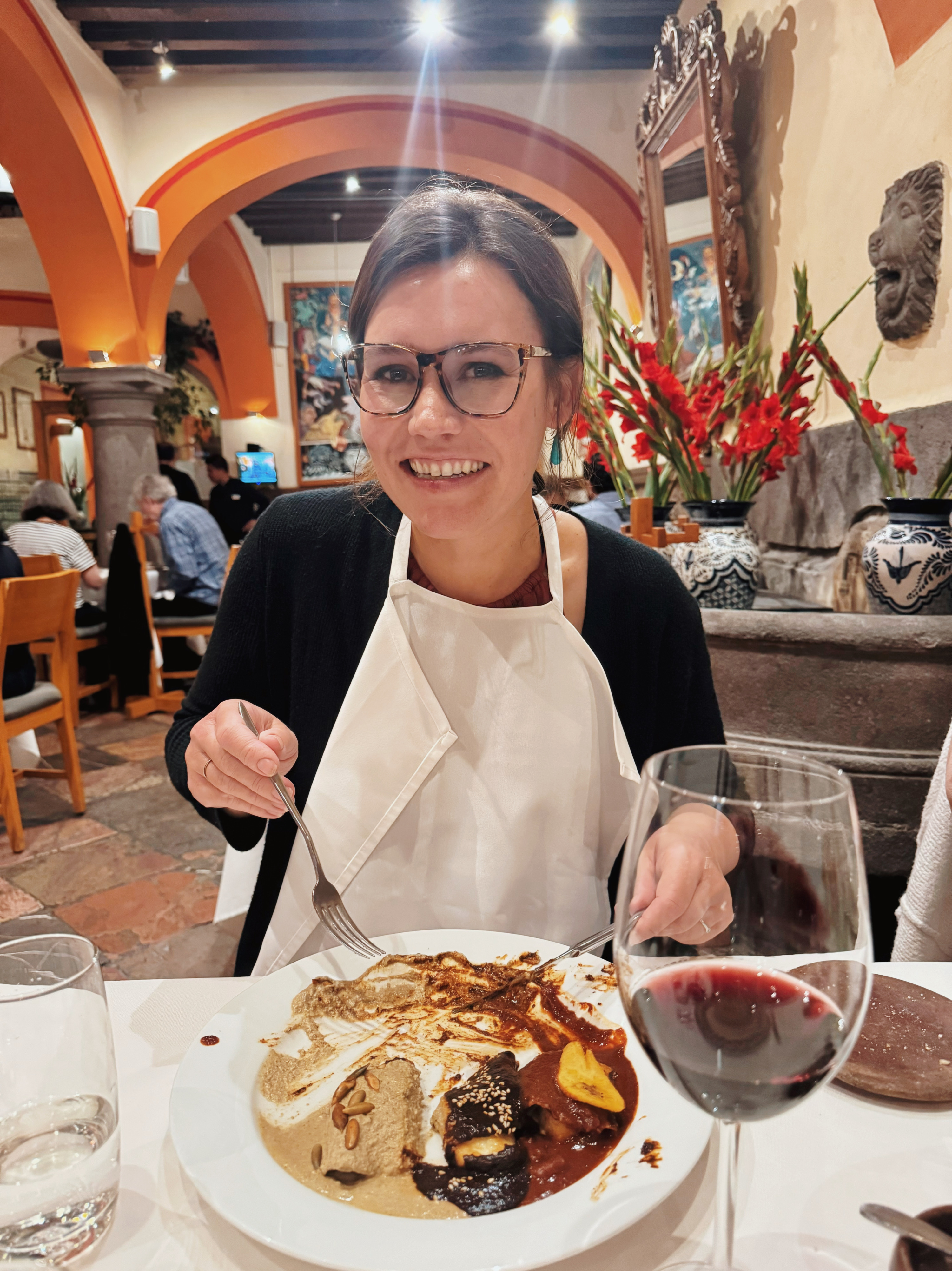
Instead, I ordered some vegetarian enchiladas, smothered with three types of mole – mole poblano, Pipián Verde, and Manchamanteles, or “dirty tablecloth“. I would find out later why. Our extremely attentive servers buzzed around our tables at an exhausting pace, providing new napkins, warm bread rolls, and finally offering a white bib as I nibbled through the appetizers. I wasn’t sure why I was the only one being offered a bib, but assumed that if they were telling me I needed one, I probably did. Our waiter promptly tied it around my neck for me. Shortly after, my enchiladas with three moles arrived. The third, red mole, was famous for staining the tablecloth, or clothes, as it were. All three were delicious and melted savorishly atop by tongue, but the Pipián Verde was my favorite, and I gobbled it down quickly.


During my quick trip to the area of Coyoacan in Mexico City, and just before visiting the Frida Kahlo museum, the tour guide showed us a wonderful restaurant in the heart of it all. A buffet with all of the Mexican favorites, and a courtyard patio to celebrate it with, called Ta’ab and just around the corner from the Fuente de los Coyotes. Not only was the food exquisite, but it really saved us the extra time of picking one of the many restaurants in the area. Coyoacan really was en mi corazón, I understood Frida Kahlo’s obsession with its quirky culture and I quickly decided that if I were to come back on my own time, I would certainly stay and explore here.

Last up on the foodie exploration was the famous Cafe La Habana, as featured in Atlas Obscura. Famous for “serving coffee, chilaquiles, and the Cuban Revolution.”
“But to think that this cafe’s claim to fame begins and ends with Castro and Guevara would be misleading, as it wasn’t just the haunt of political revolutionaries but also revolutionary writers. Some of the regulars who changed Latin American literature as we know it were known to sit for hours in the cafe, chain-smoking and discussing their ideas. Since La Habana’s opening in 1952, it’s played host to Gabriel García Márquez, Roberto Bolaño, and Octavio Paz. (Atlas Obscura)

Planning to be surprised merely by the atmosphere and not anticipating the elaborate food and desert menu we did find, we were elated to find a very full and fantastic lunch menu and some of Mexico’s most traditional options. I ordered a simple lunch special, complete with a cubano and dessert at the end (all for around $7 USD). We may have very well discussed some revolutions amongst ourselves, inspired by the same smoky seventies interior and coffee as Che Guevara 70 years ago.


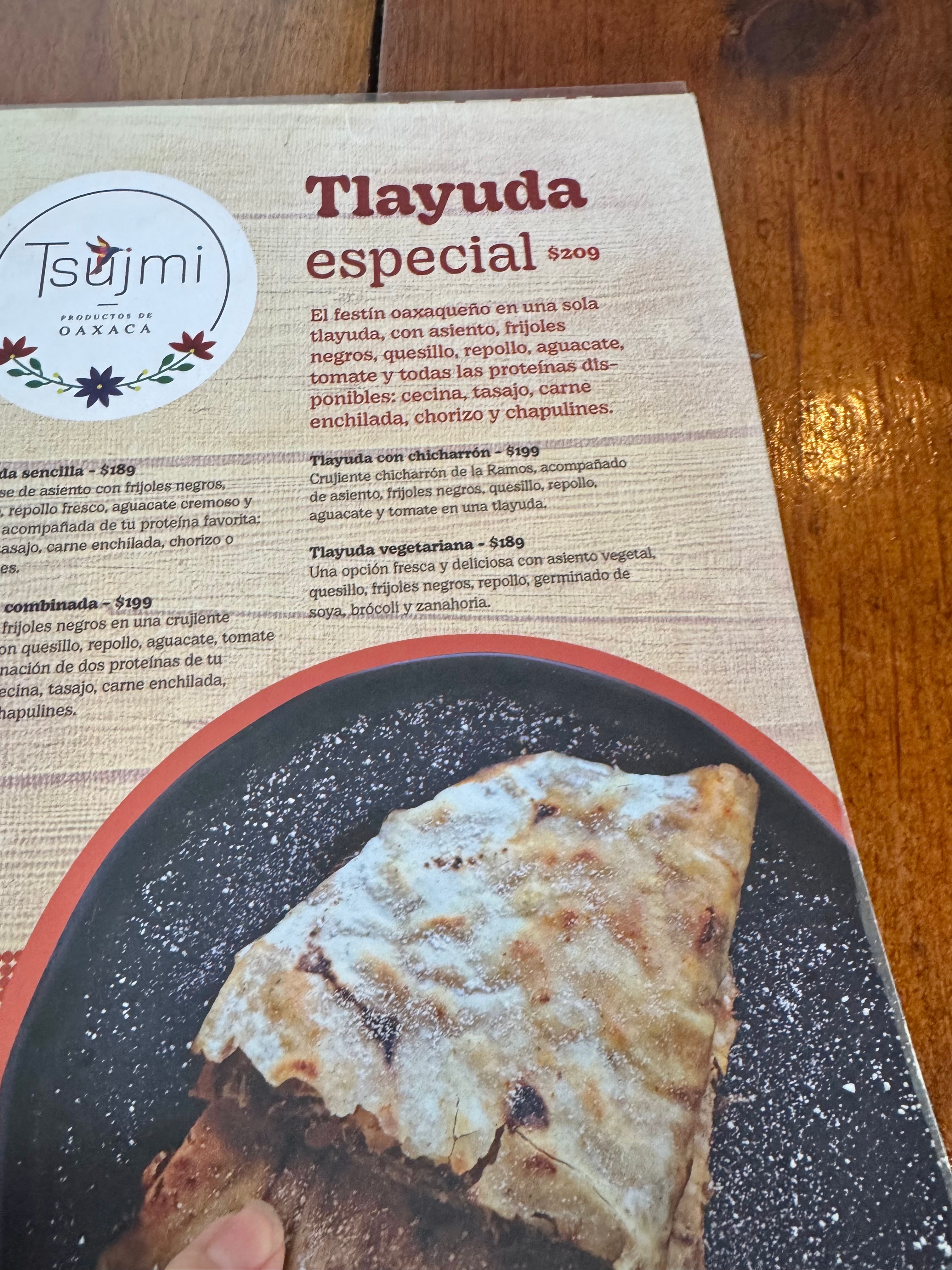
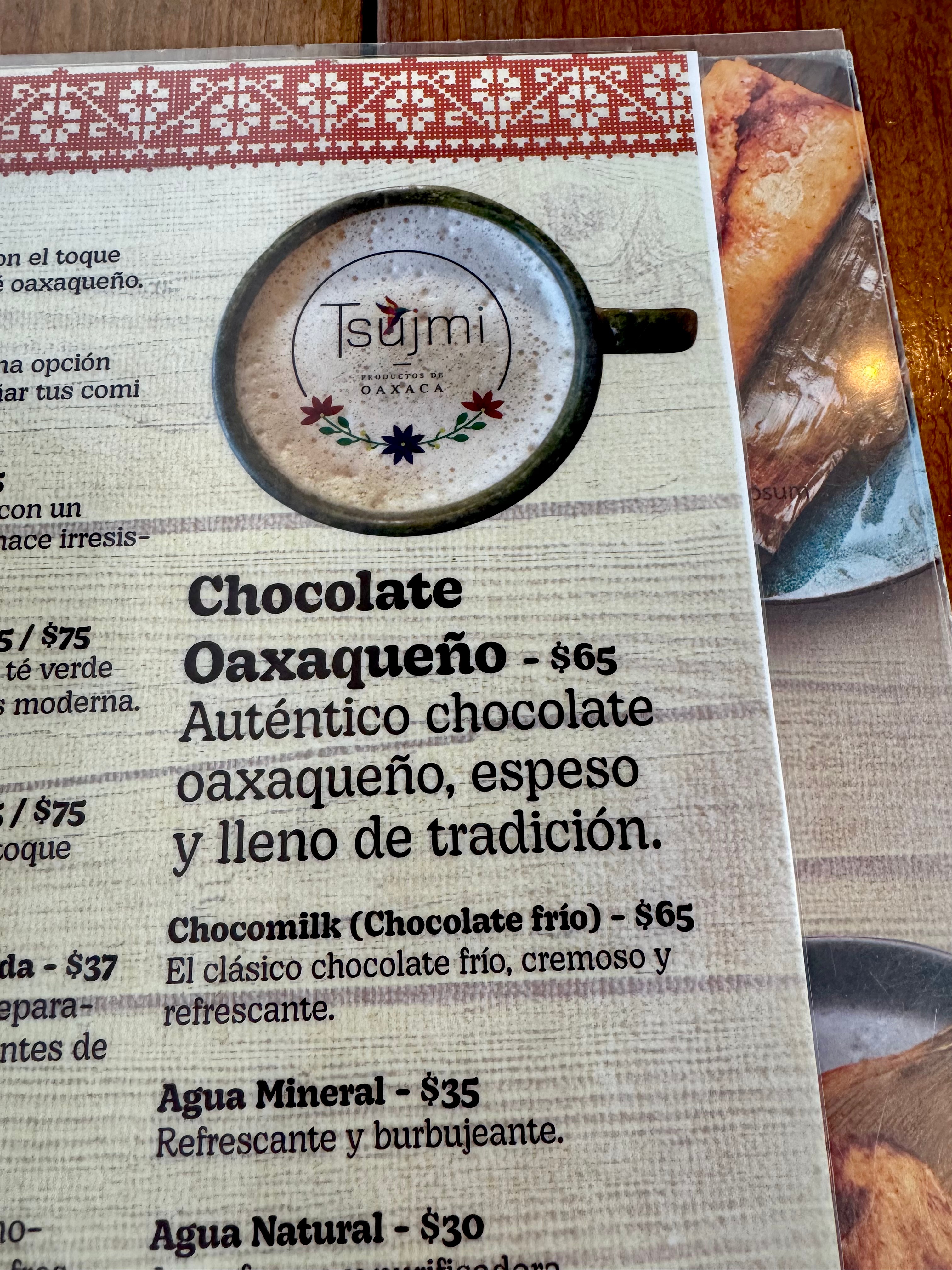
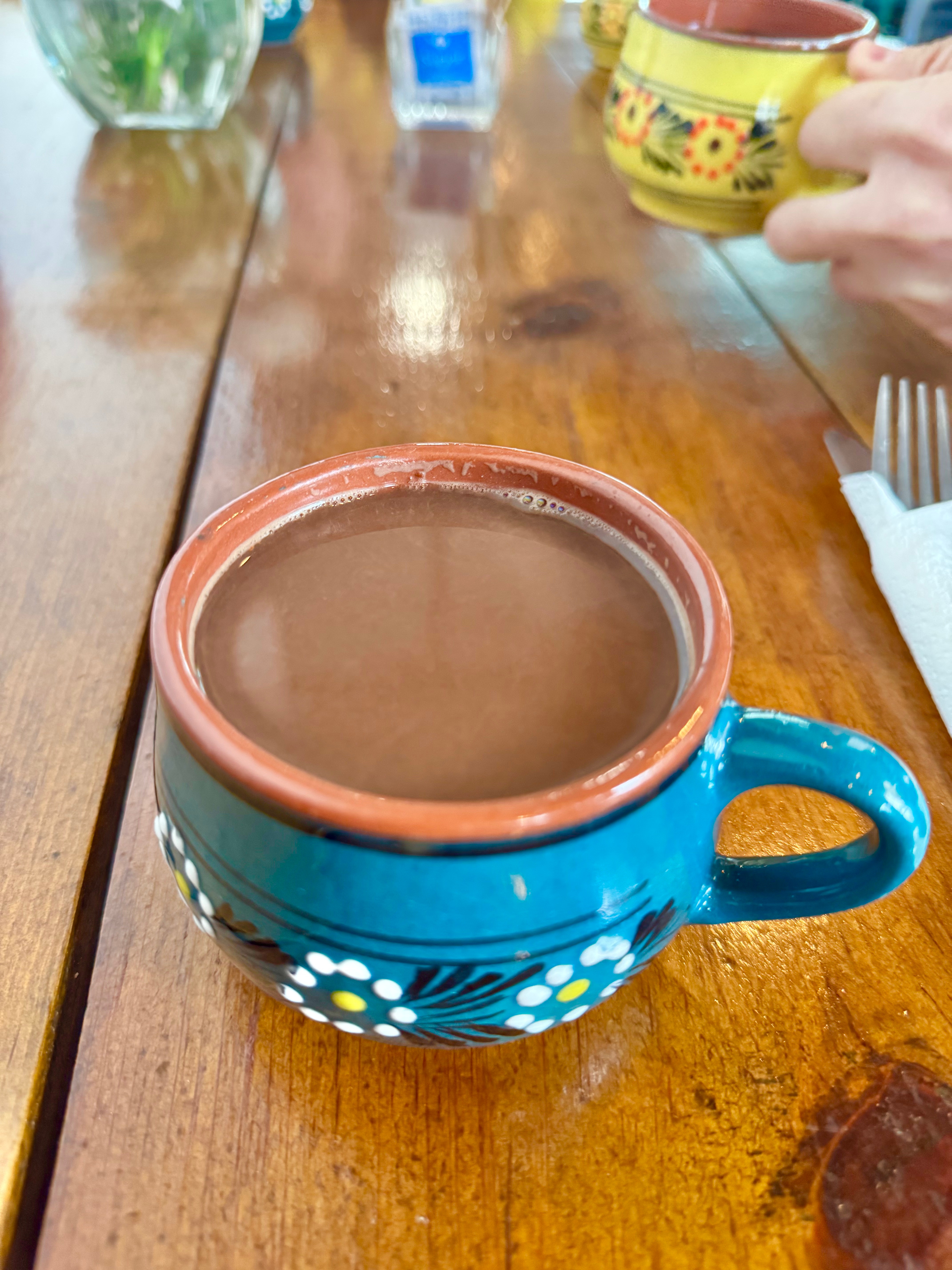
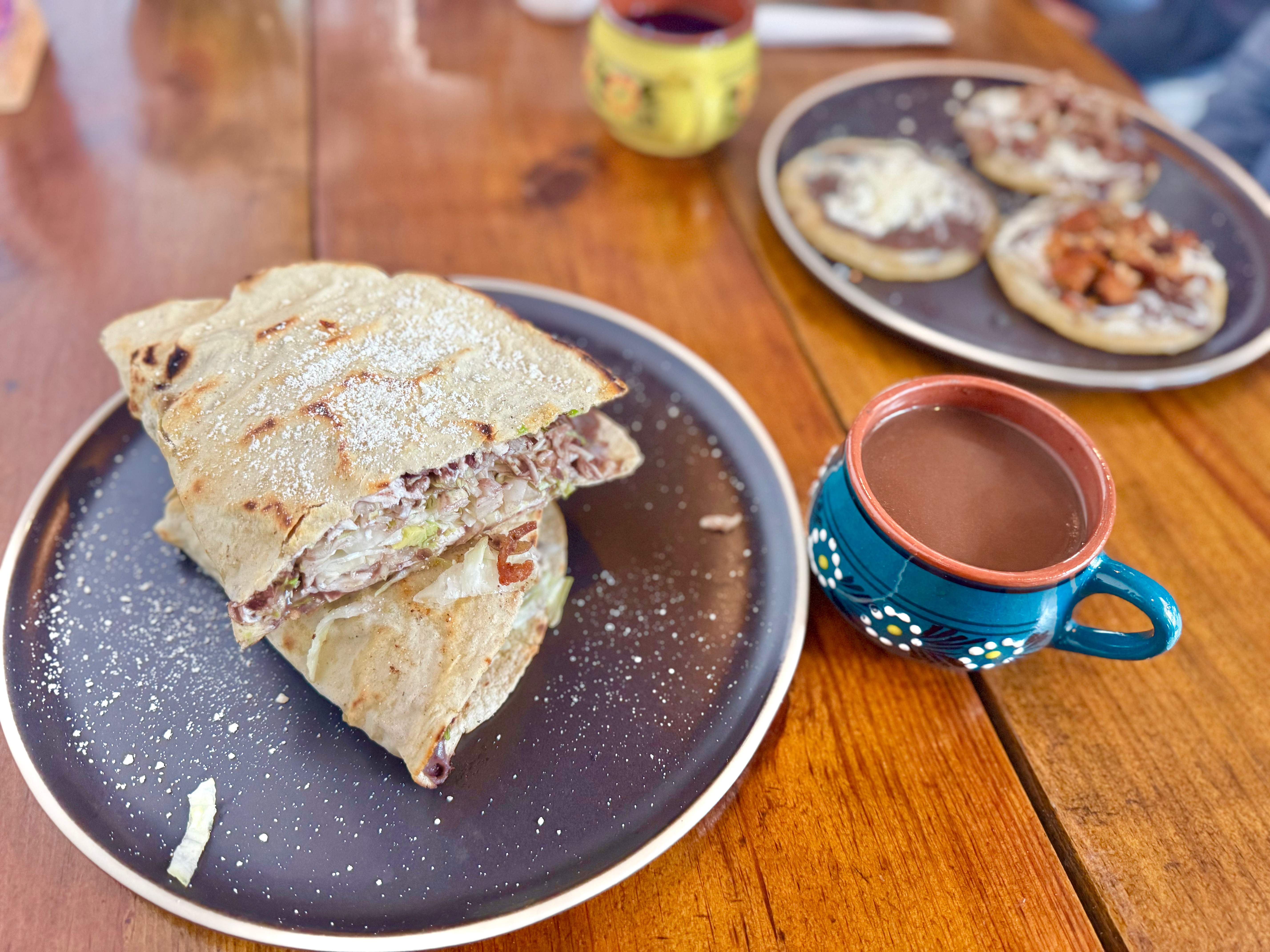
Lastly, during our very quick (24 hour) visit to Monterrey, Mexico, a modern city with a bustling population of around 5,272,360 – and Mexico’s second largest, we stopped for a quick lunch at a Oaxacan restaurant. I was able to get a taste of the Ouaxacan hot chocolate, and TLAYUDA, a delicious type of tortilla dish filled with Oaxacan cheeses.
DRINKS
I was excited to find that at a couple of the restaurants I was finally able to try Mexican wine. Living so close to the border, I would have thought it would be easier to find the local Mexican wines, because their big wine region is just a couple of hours away, but it isn’t. Mexico boasts its very own lovely wine regions, Valle de Guadalupe being one. I heard they were similar to wines grown in Spain, like Tempranillo. I was out to find a VALLE DE GUADALUPE wine, and did, at two restaurants during the trip.
MEZCAL as an alcohol is hard to describe, perhaps because I’m trying to group it into a family of other alcohols. Like tequila, it is made from the agave plant, but in an underground oven, whereas tequila is made from blue agave in above-ground ovens. My first night out, at La No. 20 I ordered the best margarita I have ever had. The mango margarita was just the perfect texture of blended drink, tequila and mango. The next day at the Villa Maria, I tried another mango margarita, but this time with mezcal instead of tequila – an option I learned was common. Everyone seemed to be going for the blended cocktails with mezcal throughout the trip, and the few drinks I did try with it added a lovely smoky flavor.


The drink I had to check off my list, but I will not be ordering again, is PULQUE. The pulque, like the crickets, is something to be checked off the list. Perhaps my taste buds are not as refined as those of the Gods, for as I would learn in the pre-hispanic era, the indigenous people made pulque, the “milky-white, sour and viscous alcoholic beverage from the sap of the agave plant.” It has a long history of production and consumption in central Mexico, where it was considered sacred and limited to certain classes of people. I will leave it to those classes.

PLACES
Perhaps the culminating highlight of the week was the trip to the FRIDA KAHLO CASA AZUL, and COYOACAN area. I was finally able to run my hand across the bright blue paint of Frida Kahlo’s Casa Azul, just as she had over 80 years ago. The house remains largely unchanged since her passing, as friends and family have vowed to keep it just as she left it.
I purchased my ticket to the Frida Kahlo museum along with my tour ticket, but heard that the tickets to the museum sell out months in advance, so be sure to book in early!
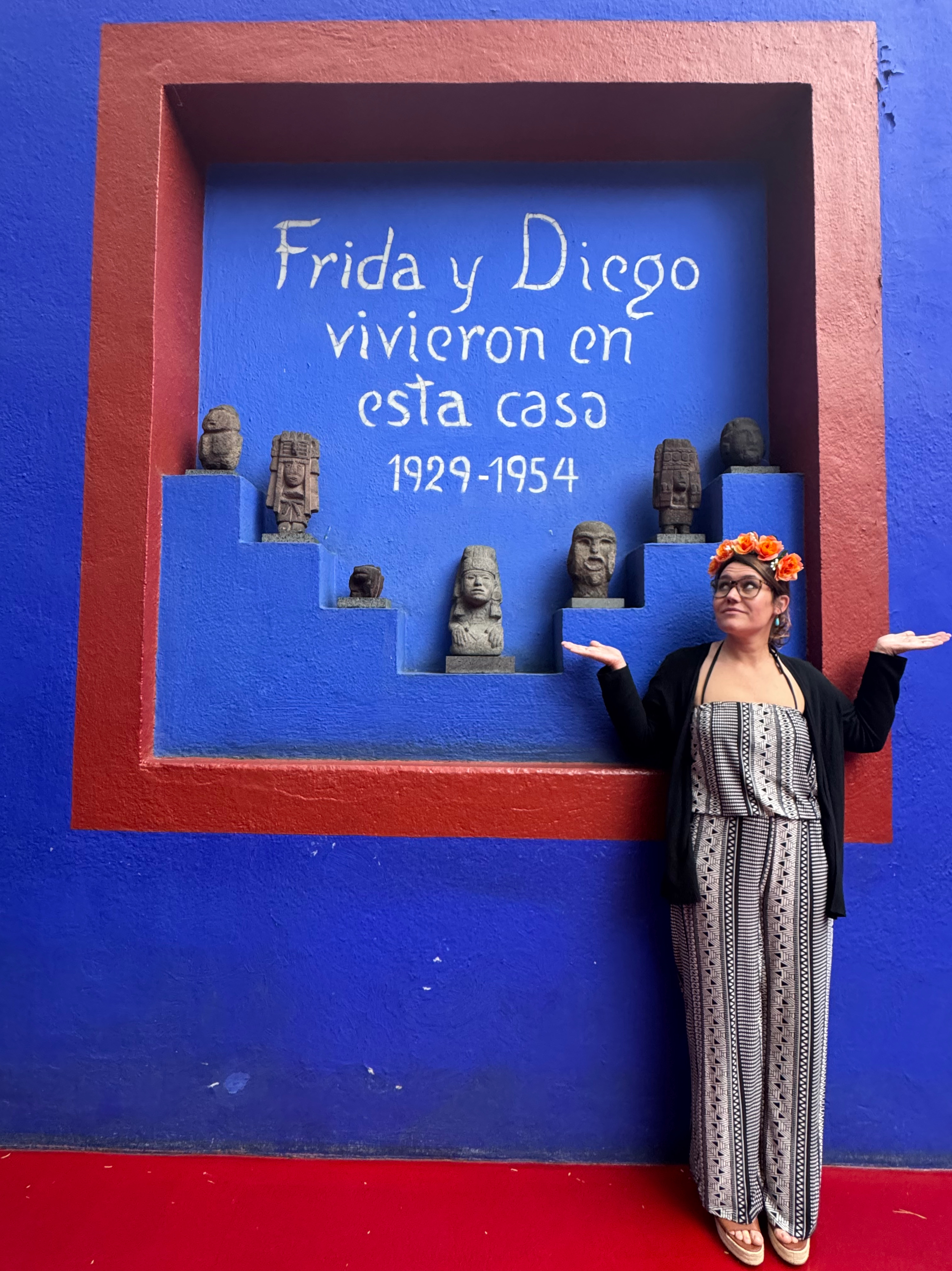

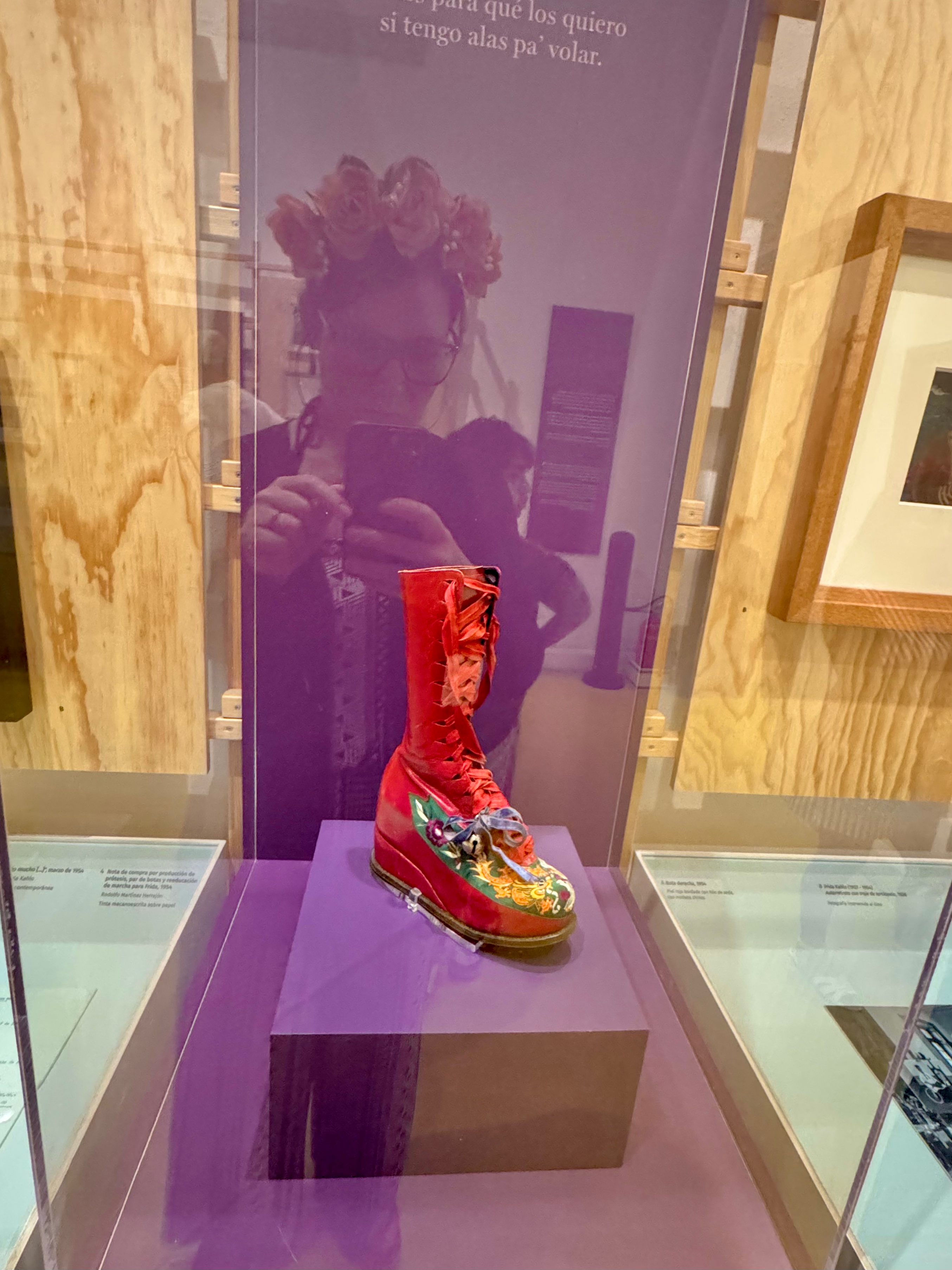
Perhaps most impressive about the visit to her house was reading about the immense pain she endured throughout her life. It can be felt within the walls of her lovely Coyoacan home. She suffered from polio as a child, only to then have her fateful bus accident further contort her body into new and painful ways. Her body was her cage, but also contained her method of setting herself free.
“Al final del día, podemos aguantar mucho más de lo que pensamos que podemos”.– Frida Kahlo


My final splurge during my little bit of free time on the (work) trip was to the famous floating gardens of the Aztecs, called the XOCHIMILICO, just outside of the city.
There seem to be plenty of the boats, owned by private owners, tour companies, individuals, and people rent out many of them at once to host their own party. The vendors scoot their smaller boats right up beside yours to offer their goods, from snacks, to pulque, margaritas, elote, to more exotic things- such as fruit, pythons, or eagles! Many of the exotic creature stops are alongside the water too, so your boat can just park right up next to one and you can pet a real live Axotyl or python, if you’re into that. I am, but it wasn’t part of our tour.


Puebla, Mexico
A quick two hour bus ride up a windy mountain road from Mexico City will find you at one of Mexico’s oldest establish towns, home to the Battle of Puebla (which began the celebration of Cinco de Mayo). We visited the fort and location of that battle the next day.
“Cinco de Mayo, or the fifth of May, is a holiday that celebrates the date of the Mexican army’s May 5, 1862 victory over France at the Battle of Puebla during the Franco-Mexican War. The day, which falls on Sunday, May 5 in 2024, is also known as Battle of Puebla Day. While it is a relatively minor holiday in Mexico, in the United States, Cinco de Mayo has evolved into a commemoration of Mexican culture and heritage, particularly in areas with large Mexican American populations.” (History.com)
Home to rich culture and designated a UNESCO World Heritage Site, the historic heart of Puebla was a captivating surprise. The large city is also nestled between two active volcanoes, Matlalcueyetl and Popocatépetl, which you can see on rare clear sky days, when not overshadowed by the air pollution.
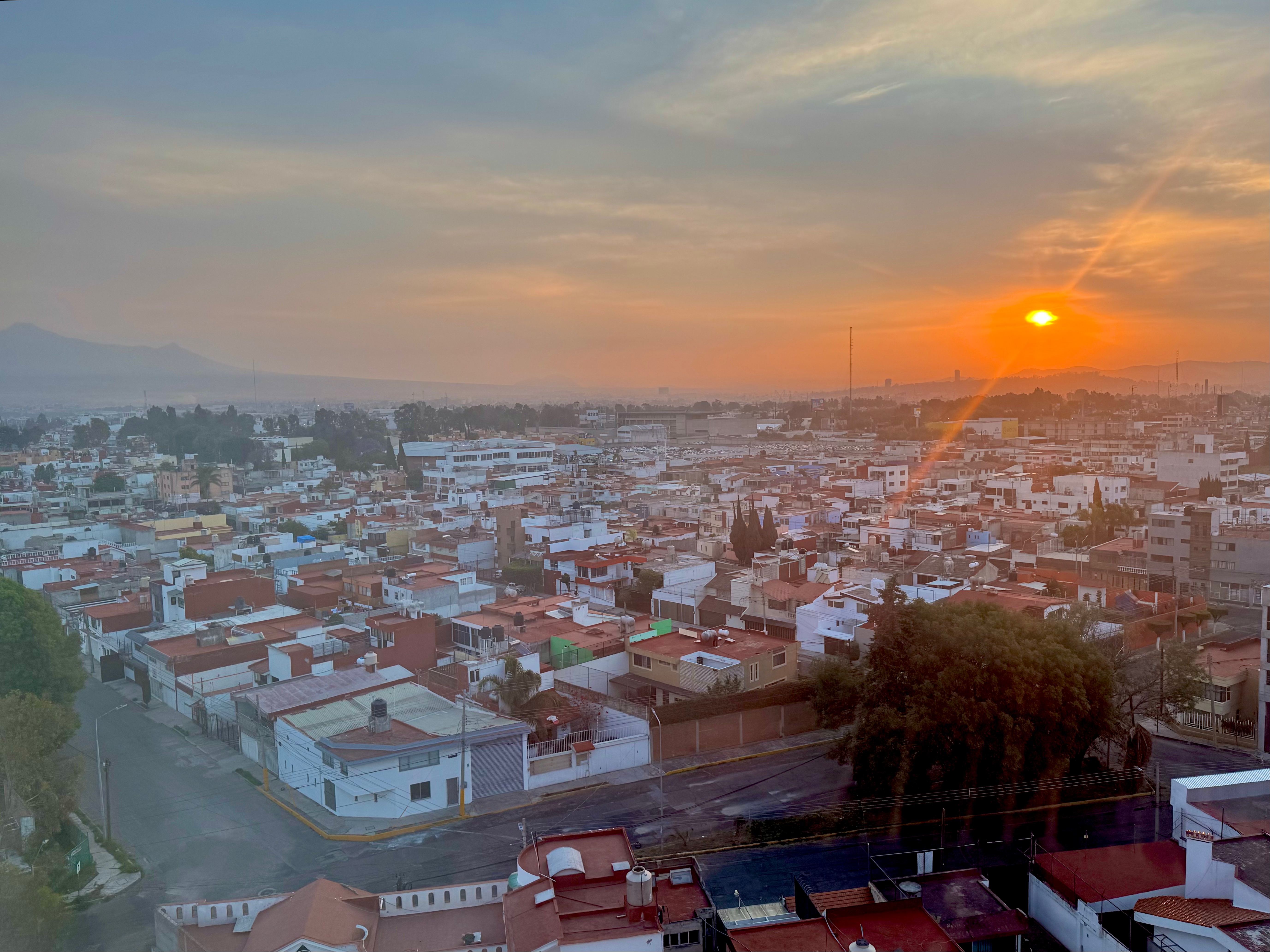

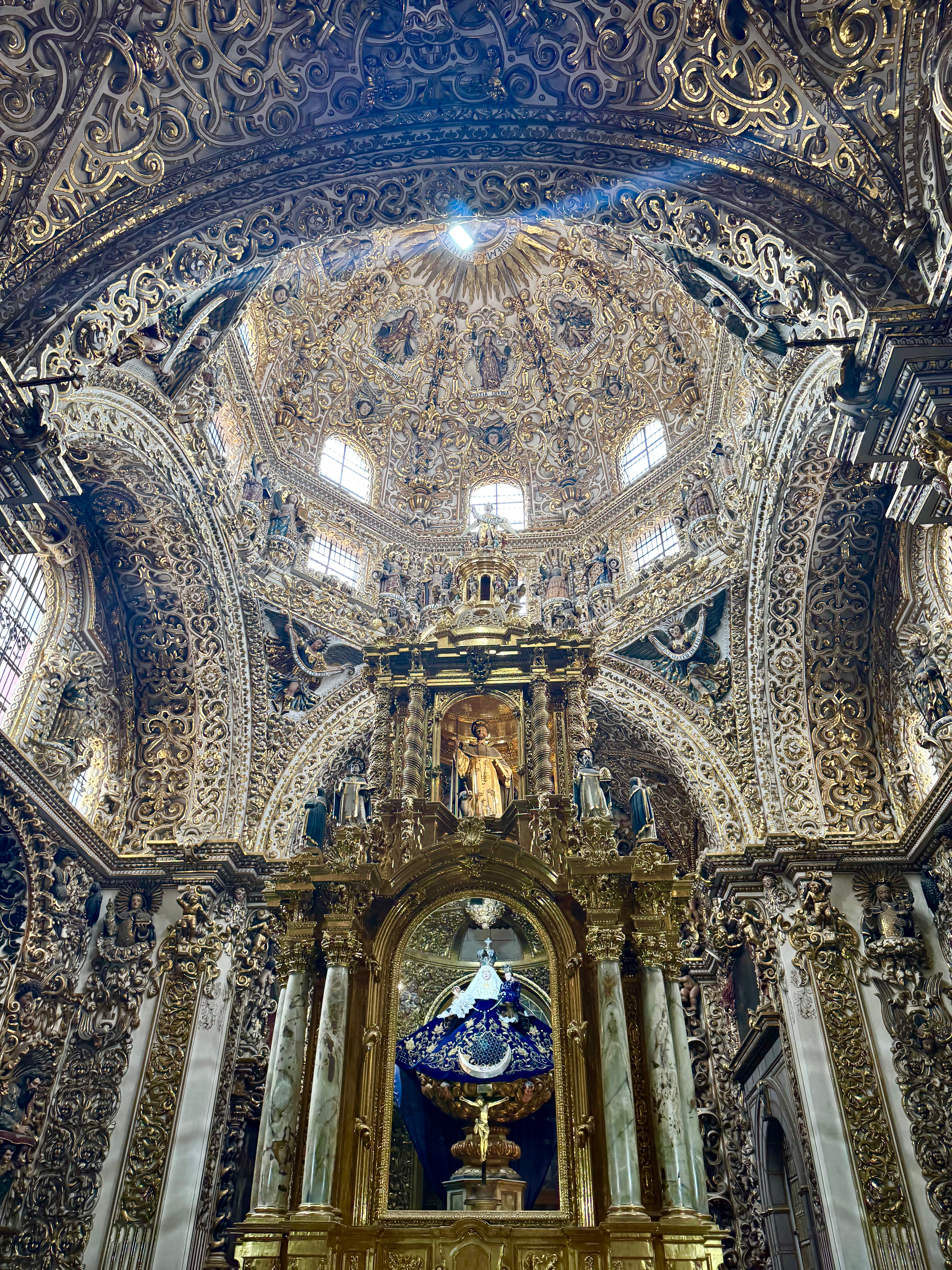
We made a quick stop into the gold lined Catedral de Puebla -“the second-largest in the country after Mexico City Cathedral and its twin bell towers are the tallest in Mexico at 226 feet (69m)”. One of them can be climbed for excellent views of the city and surrounding volcanoes.” Contruction began in 1535, but not consecrated until 1649.” (Sacred Destinations.com)

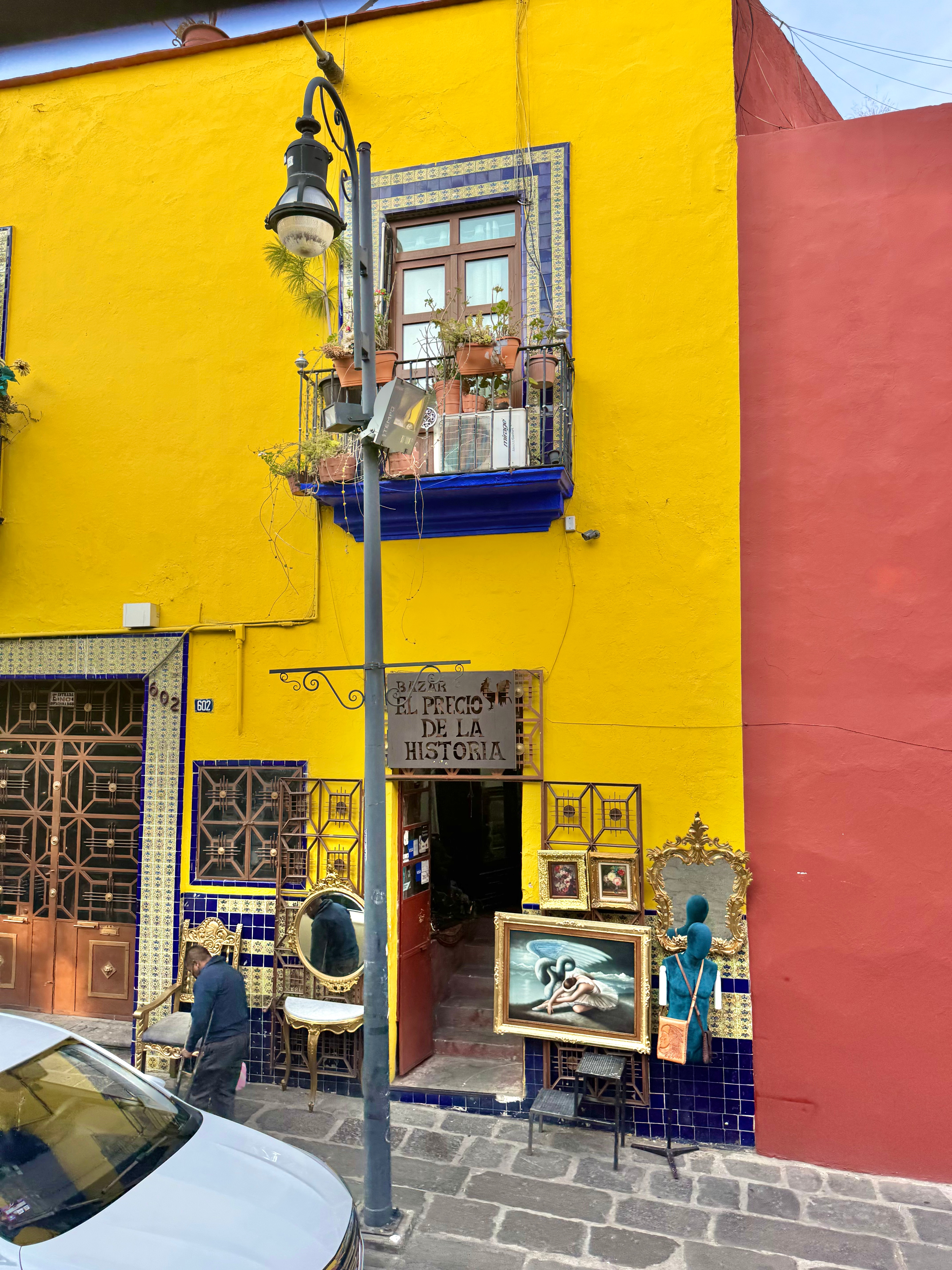

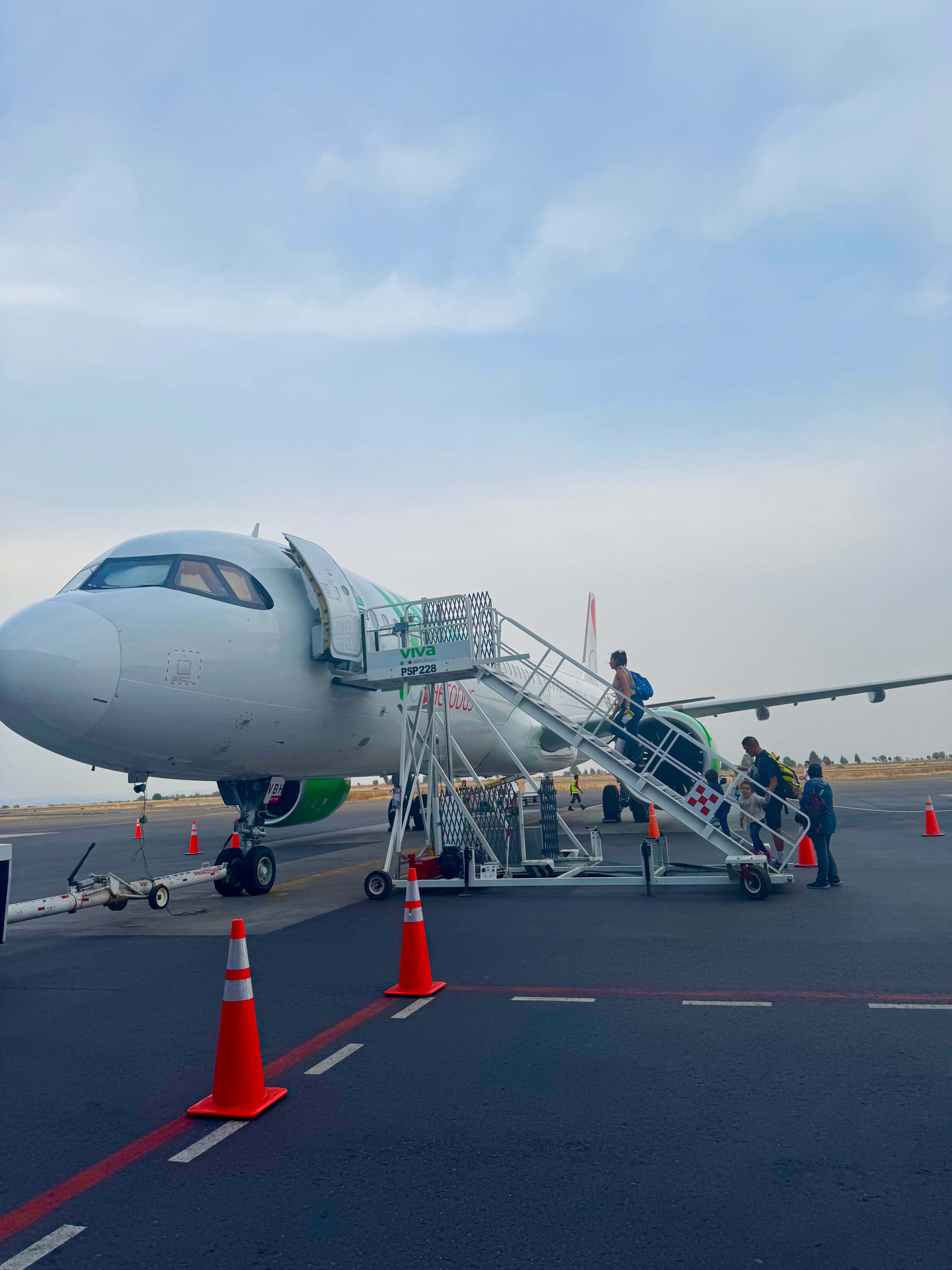
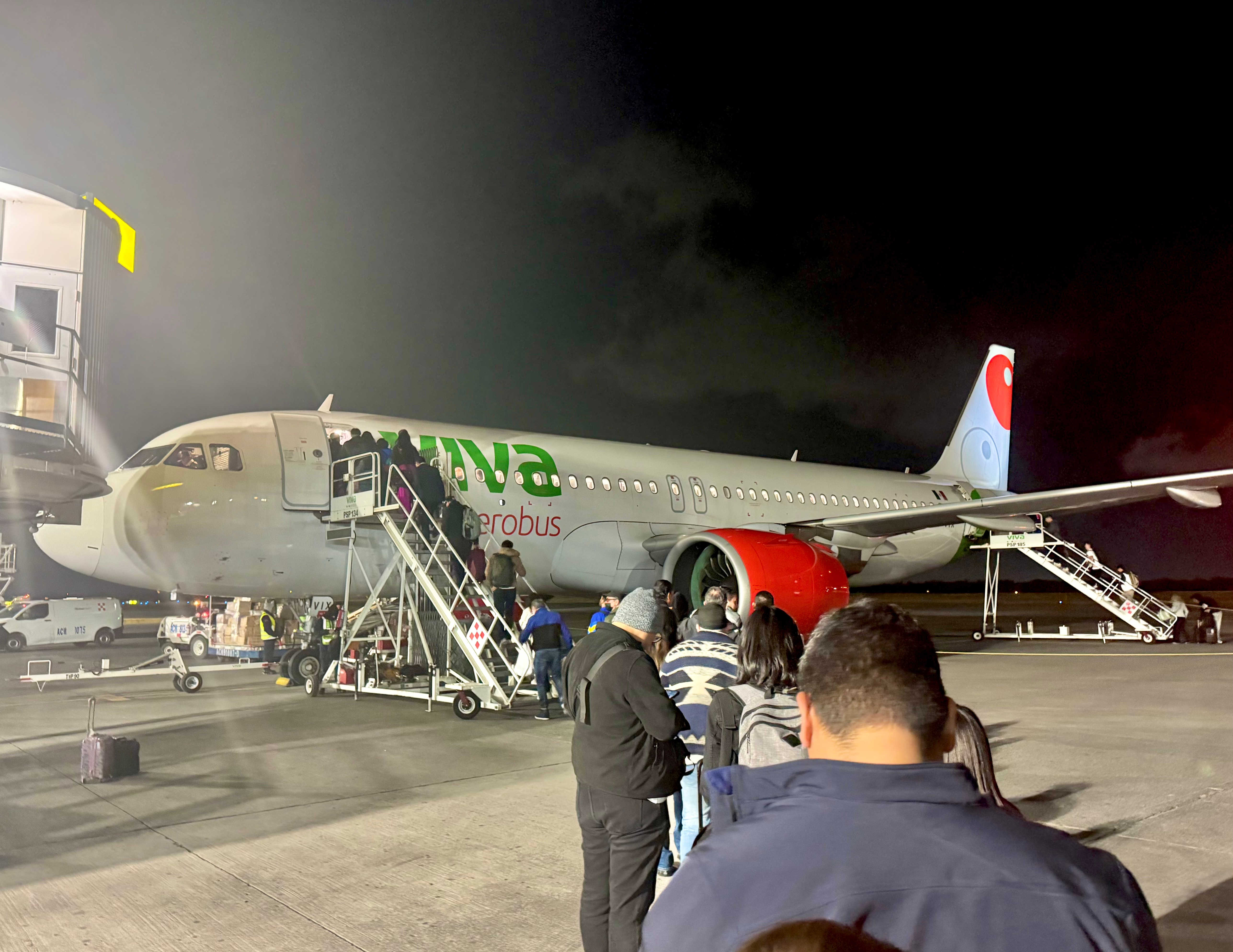
I quickly fell in love with the friendly people of the Mexican cities I visited. Everyone was so helpful, and happy to share their food and culture with me. Even with my broken Spanish, though I tried very hard. I was impressed with their airports and flights, the inter-country Viva flights were very comfortable and affordable. After speaking with many expats in the Mexico City area, and with at least two locals in Spanish about how they preferred the speed of the lifestyle in Mexico, I couldn’t help but wonder what it might be like to live there, too.
 Poesie Sans, Souci
Great Read!